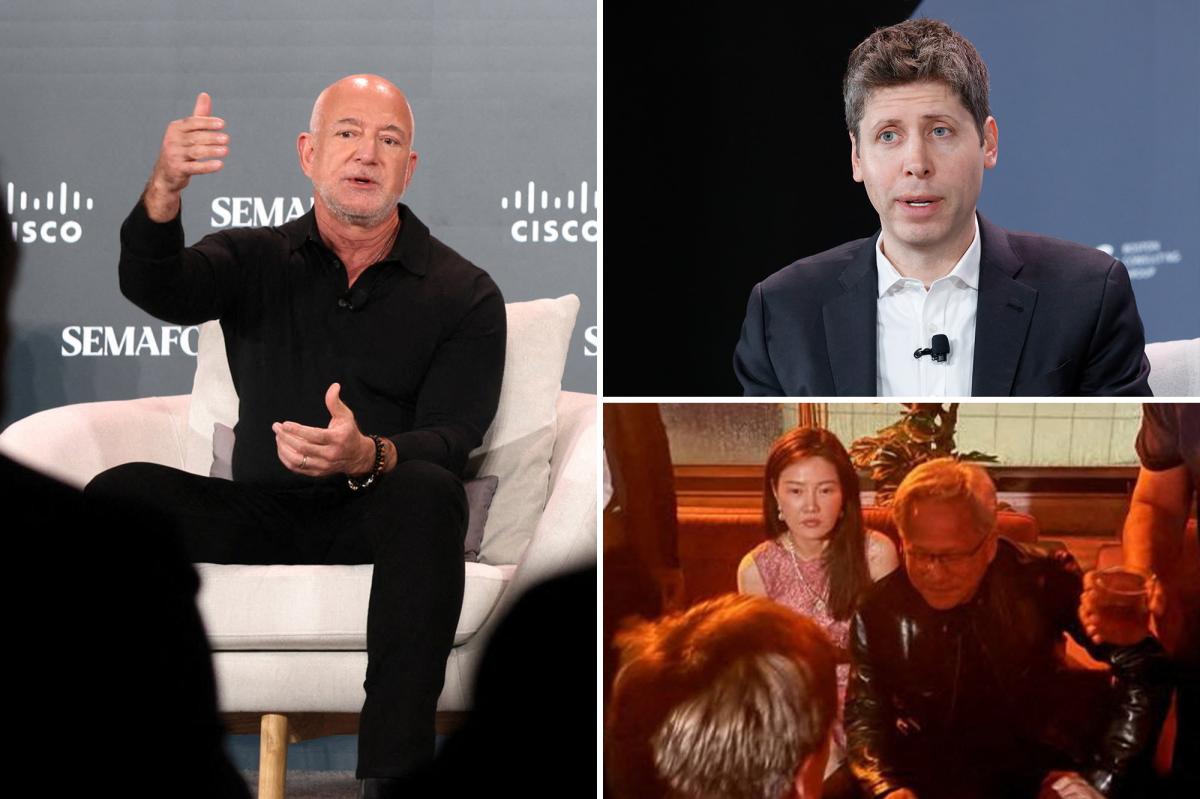
Few stories have gripped Silicon Valley this year like the turmoil surrounding Jensen Huang, who resigned as chief executive of Nvidia last week following reports of extramarital affairs, then made a brief and unsuccessful attempt to return.
The episode dominated conversation this week at Semafor's Silicon Valley & The World forum, which drew tech executives, investors, policymakers and government officials. According to a report by the New York Post, several of the industry's most prominent figures used the event to share their views on Huang, Nvidia's future and the wider implications of the scandal.
Sam Altman Expresses Empathy for a Longtime Hero
OpenAI co-founder and CEO Sam Altman said on Monday that he feels deep personal empathy for Huang. Altman, who was himself ousted as OpenAI's chief executive in 2023 before being quickly reinstated, described Huang as someone he has long admired.
Altman declined to say whether Huang should return, explaining that he did not know enough to judge. He acknowledged that heroes have flaws but stressed his gratitude for what Huang built, noting that Nvidia made an early bet on OpenAI and OpenAI made an early bet on Nvidia in return.
"It's hard to imagine the AI revolution without Jensen," Altman said. He added that Nvidia remains an enormous company and that, in his view, customers still place strong trust in its commitments.
Jeff Bezos Advises Nvidia's Board Against an Outside Hire
Amazon founder Jeff Bezos also said he lacked the details to weigh in on a possible Huang return. He nonetheless called Huang a remarkable founder who built an exceptional company through hard work and foresight, and said that admiration should endure regardless of what happens.
When asked what guidance he would give Nvidia's directors, Bezos said that if Huang is not brought back, the board should choose a successor from inside the company. He argued that Nvidia is too complex for an outsider and that external CEOs at complicated companies rarely succeed, making that route a last resort.
Bezos, who stepped down as Amazon's CEO in 2021 after 27 years and remains executive chairman, dismissed any comparison between his own departure and Huang's. He drew laughter from the audience by emphasizing that his handover was a carefully planned, multiyear transition, which he called a very different situation.
Andy Jassy Sees No Disruption to the Amazon Partnership
Amazon CEO Andy Jassy said he does not expect the upheaval at Nvidia to affect his company. Amazon buys Nvidia's chips while also designing its own custom silicon, a relationship Jassy characterized as coopetition and described as a normal feature of the technology business.
Jassy called Nvidia a long-standing and important partner and said he expects that to remain true for the foreseeable future. Nvidia will need to decide its own path forward, he said, but Amazon intends to keep working with the chipmaker either way.
Perplexity's Aravind Srinivas Credits Huang for a Generation of AI Success
Perplexity AI co-founder and CEO Aravind Srinivas praised Huang in an interview with The Associated Press on Monday. He said that virtually everyone who has risen to prominence in AI over the past four or five years owes a debt to Huang.
Srinivas described Huang as singular and said the country would benefit from more leaders like him, encouraging others to aspire to a comparable legacy. He did not say whether Nvidia's board should reinstate Huang.
Gina Raimondo Ties the Scandal to Chip Export Controls
Former Commerce Secretary Gina Raimondo, who held the post from 2021 through 2025, said on Tuesday that the affair has drawn attention to U.S. rules on exporting sensitive technology. One of the women Huang reportedly had a relationship with was an executive at a Singapore-based cloud computing firm that U.S. officials suspected of diverting advanced Nvidia chips to China in breach of export controls.
Raimondo said her approach in office was to be transparent with chipmakers about the rules and expect compliance, while putting national security first. She acknowledged that companies were not always pleased because they want to maximize sales, and said she tried to limit lost revenue so American firms could still thrive.
Now CEO of RAISE US, a nonprofit studying how AI will reshape jobs and industries, Raimondo said she started work two years ago on limiting remote access to advanced U.S. chips and servers. The Trump administration issued new rules on that issue on Monday. She said she was unsure why it took so long but welcomed the move, arguing that given China's ambitions there should be zero tolerance for corruption, mishandling or dealings with spies.
What the Reactions Reveal About Nvidia's Place in Tech
The comments underline how central Nvidia has become to the AI economy. Even as leaders avoided taking sides on Huang's future, they were consistent in crediting him with enabling much of the industry's recent progress and in signaling that their business ties to Nvidia remain intact.
For founders and investors, the episode is a reminder that leadership risk at a single critical supplier can ripple across an entire sector. Raimondo's remarks also suggest that scrutiny of how advanced chips are sold and accessed abroad is likely to intensify, regardless of who ultimately leads Nvidia.
Source: New York Post