When a large technology company is described as adding AI capacity, the phrase can cover very different arrangements. The company might own an entire facility, lease an empty building and fill it with its own hardware, or simply rent computing power that someone else owns and operates.
An analysis published by Global Data Center Hub breaks the modern AI data center into six ownership layers: electricity, the building, power and cooling equipment, chips, computing services and network connections. Its central suggestion is simple. For any company named in a data center story, ask which of those layers it actually controls.
A recent agreement between Meta and AI cloud provider Nebius offers a clear example of why the question matters.
Electricity Comes From Utilities and Their Suppliers
The first layer is power, which usually comes from local utilities. The International Energy Agency's 2026 update on energy and AI found that most data centers prefer a grid connection, and estimated global data center electricity use at about 485 terawatt-hours in 2025, rising to roughly 950 terawatt-hours by 2030, or about 3% of world demand.
Utilities in turn depend on equipment makers. Siemens Energy announced a $1 billion US program in February 2026 covering transformers and gas turbines, and the IEA recorded a 70% rise in gas turbine orders in 2025.
This is also where public resistance is strongest. The IEA noted growing community concern about affordability and environmental effects tied to new data center projects.
Landlords Own the Shell, Tenants Fill It
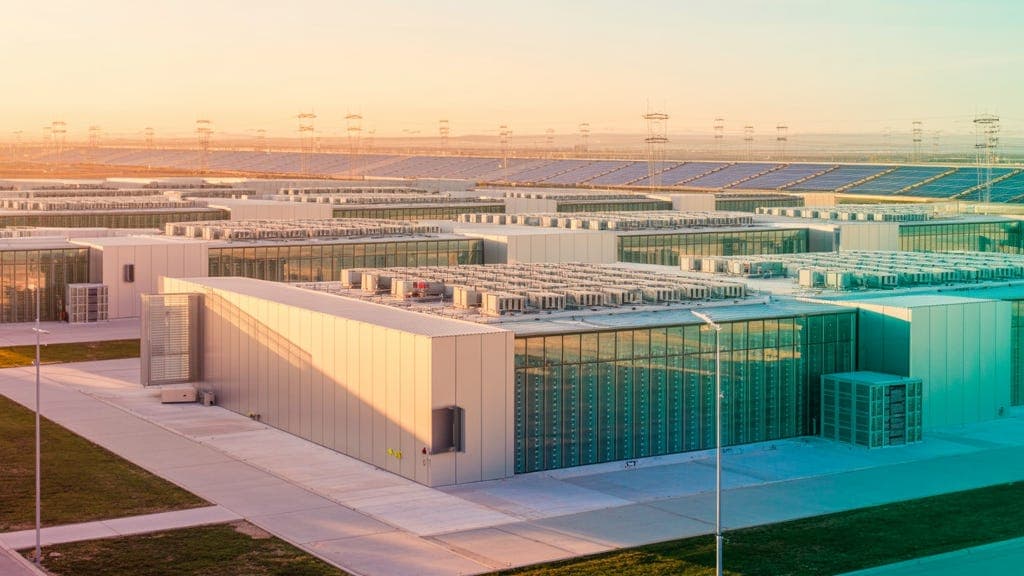
The second layer is the building itself, which often works like an unfurnished rental. Real estate firm JLL forecast that average global construction costs would climb 6% to $11.3 million per megawatt in 2026, a figure that covers only the structure and core systems.
The computer equipment is typically the tenant's responsibility, and it can be the larger expense. JLL projected about $1.2 trillion in new data center property value between 2026 and 2030, with tenants potentially spending another $1 trillion to $2 trillion on equipment, bringing combined spending close to $3 trillion.
Cooling, Power Gear and the Chips Inside
The third layer is the equipment that delivers power to servers and removes their heat, increasingly through liquid cooling. Suppliers are consolidating: Schneider Electric completed its purchase of a 75% stake in liquid cooling specialist Motivair in February 2025 and expects to acquire the rest in 2028.
That gear must keep pace with chip designs. NVIDIA says it is leading a shift to 800-volt direct current power beginning in 2027, aimed at racks that each draw around a megawatt.
The fourth layer is the chips and the high-bandwidth memory beside them. Micron said it began volume shipments of its HBM4 memory, built for NVIDIA's Vera Rubin platform, in the first quarter of 2026. The IEA expects shortages of this memory to last until at least the end of 2027.
Renting Compute: The Meta and Nebius Arrangement
The fifth layer is the service provider that owns and runs AI hardware and rents out its capacity. In March 2026, Nebius announced a five-year agreement to deliver $12 billion of dedicated computing capacity to Meta across multiple locations, starting in early 2027.
Meta also agreed to purchase additional capacity from upcoming Nebius clusters, up to $15 billion over five years. Nebius plans to sell that extra capacity to other customers, with Meta buying whatever remains unsold.
The capacity serves Meta, but it is delivered and operated by Nebius. A reader seeing a headline about Meta's AI capacity might reasonably picture Meta-owned machines in a Meta building, which is not what this deal describes.
Fiber Networks and Risks Outside the Building
The sixth layer is connectivity through fiber-optic cables, which usually belong to yet another company. In September 2026, Verizon and Corning announced a multi-billion-dollar agreement covering more than 80 million miles of optical fiber and related equipment from 2027 to 2032, serving broadband and the long-distance backbone large cloud companies need for AI.
Uptime Institute's May 2026 outage analysis found that power remains the leading cause of serious outages, but failures outside the data center are becoming more prominent, and fiber-related outages are rising and more likely to cause extended disruption.
Why the Ownership Question Matters
For investors, founders and business readers, the layered view is a practical tool. Knowing which layer a company owns clarifies what it has actually committed to and how many other suppliers must still deliver before an AI product works.
It also highlights where bottlenecks may emerge. As data center electricity use moves toward the IEA's 2030 projection, the key question is which of these many owners will be slowest to keep up.
Source: Global Data Center Hub