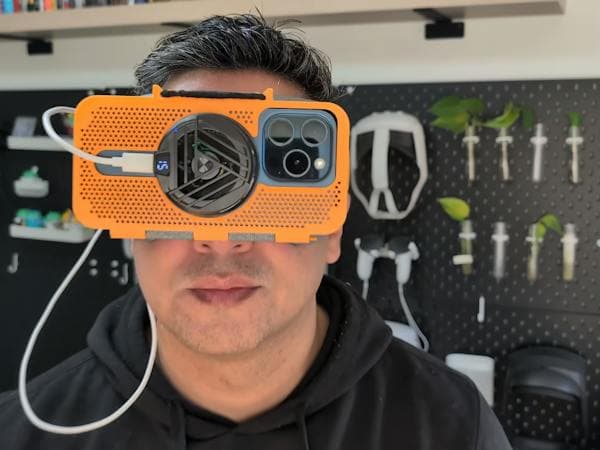
The Apple Vision Pro launched at $3,499, a price that reflected both Apple's premium positioning and the costly hardware packed inside. A maker who goes by Brenpoly has now tried to approximate much of that experience using an iPhone and roughly $5 worth of printed plastic.
The project is not a hardware rival to Apple's headset. Instead, it is a phone-based viewer paired with custom software, and the software is where most of the effort went, according to a report by Hackster.io.
A Headset Shell Rather Than a Headset
The $5 figure covers the headgear, which works much like the familiar cases that hold a smartphone in front of the wearer's eyes. The phone handles all of the extended reality processing and display work.
The printed frame exists to keep the iPhone steady and positioned correctly. That makes the comparison to the Vision Pro a matter of functionality, not of matching Apple's specialized components.
Designing the Frame With an AI Agent
Brenpoly created the headgear design himself, using an AI agent inside Autodesk Fusion connected through an MCP server. The agent helped model an iPhone from Apple's official technical drawings, and the headset was then shaped around that model.
The parts were 3D-printed, while the lenses were bought off the shelf. The design also includes a rack-and-pinion mechanism for diopter adjustment, letting the wearer fine-tune focus.
Rebuilding Vision Pro Features in Unity
The central goal was to see whether an iPhone strapped to the face could perform the kinds of tasks the Vision Pro handles. Brenpoly built an app in Unity and added features step by step, drawing on the integrations that expose the phone's hardware.
Although the work targeted the iPhone, he structured it to rely on each platform's native tools so Android support would remain possible. On iPhone the app uses ARKit, on Android it would use ARCore, and Unity picks the right framework at build time.
One example of the recreated functionality is gesture control. AI running locally on the phone tracks the user's hands, allowing interaction without a handheld controller.
Heat Becomes the Main Obstacle
The software reportedly covers most of what the Vision Pro does, but running it all demands significant power, and that power turns into heat. Phones are not designed to sustain that kind of load for long periods.
To cope, the app automatically scales back certain features when the phone's temperature climbs. Brenpoly also attached a MagSafe fan for active cooling and added an extra battery to extend run time.
What the Project Shows About Low-Cost Spatial Computing
Smartphone-based headsets have long been seen as novelties, and the Hackster.io writer admitted to holding that view before seeing this build. The project suggests modern phones, with mature AR frameworks and on-device AI, can deliver more than many assume.
For developers and hardware startups, it also highlights how AI-assisted CAD tools and cross-platform engines like Unity can compress prototyping work. Thermal limits remain a real constraint, but the gap between a premium headset and a phone in a plastic shell may be narrower in software than its price tag implies.
Source: Hackster.io