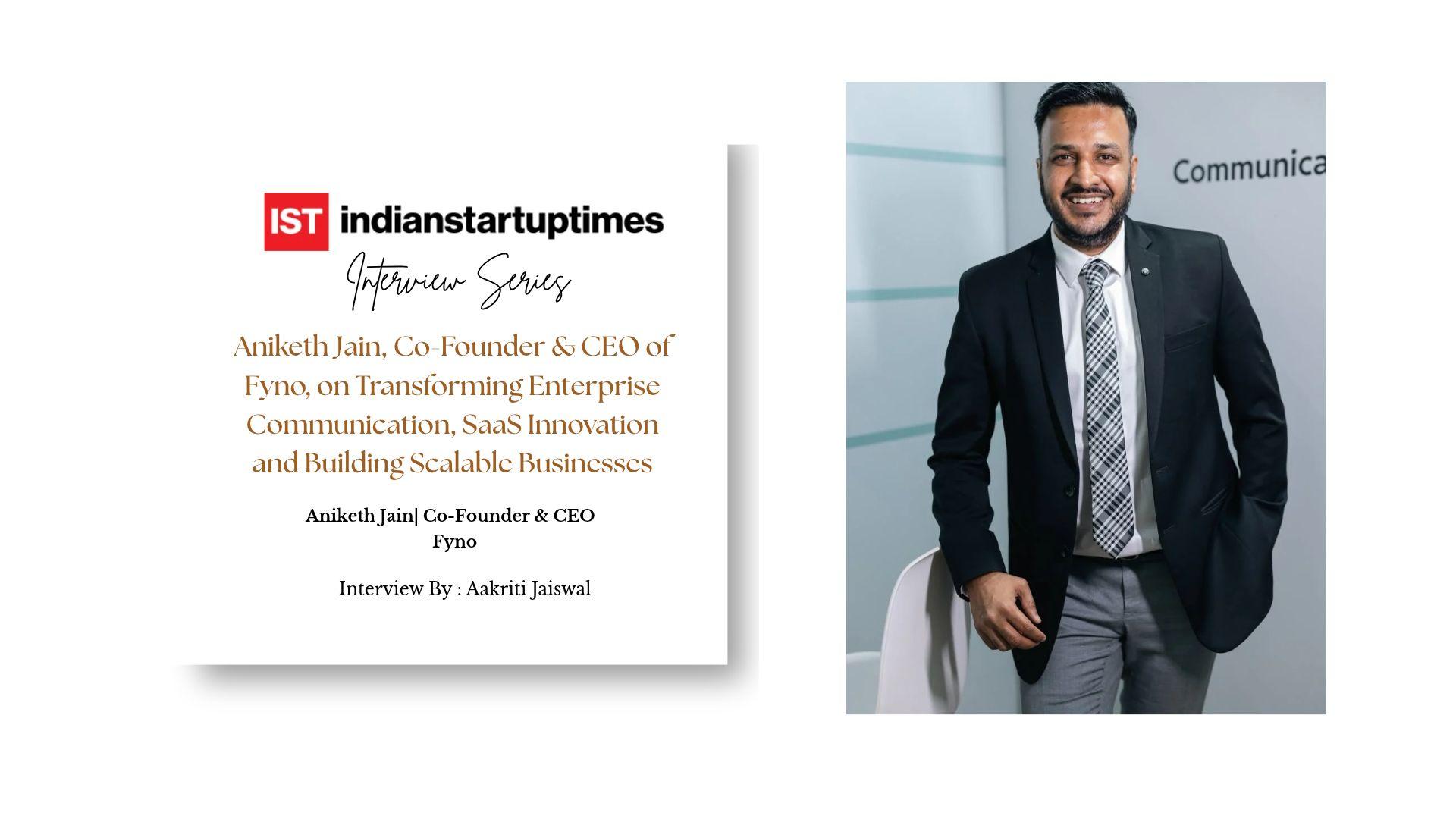
For banks, lenders and insurers, a delayed one-time password or a duplicate message is a customer experience failure and, increasingly, a compliance concern. Fyno, an enterprise communication startup, is built around giving these organisations a single place to run and govern their customer messaging.
In a conversation reported by Indian Startup Times, co-founder and CEO Aniketh Jain discussed why the company chose to specialise in the banking, financial services and insurance sector, how regulation is reshaping communication infrastructure, and what he has learned about building enterprise software over more than a decade.
A Founder Who Started Early
Jain launched his first company in 2009, at the age of 20, after completing a degree in Computer Applications. A childhood interest in computers gradually turned into a career spent building technology businesses.
Looking back, he points to three lessons that stayed with him: aiming high, keeping a strong work ethic, and spotting opportunities that a business can grow on. Years of company building, he says, also taught him to value patience and to think in long horizons rather than quick wins.
The Problems That Shaped Fyno
The idea for Fyno came from issues Jain saw firsthand in enterprise communication. Companies were struggling with late customer messages, OTPs that failed to arrive in time, repeated or unwanted notifications, and uneven experiences across platforms.
Fast-growing digital businesses also needed infrastructure that could keep up with their expansion. Jain saw room for a product that combined scale, an intuitive interface and quicker turnaround on customer needs.
Over time, the company's ambitions moved beyond simply delivering messages. Many organisations lacked a central system to oversee communication, see a unified picture of customer interactions and manage message templates, and that gap became the foundation of Fyno's platform.
Why the Company Chose to Specialise in BFSI
Fyno initially explored serving several industries but concluded that BFSI offered a distinct opportunity. The sector operates under heavy regulation, handles sensitive customer data and runs large-scale operations that demand robust technology.
Jain argues that a general-purpose product often falls short for regulated businesses, particularly where data protection and cybersecurity are concerned. The company spent considerable time studying the market and refining its go-to-market plan before committing to the sector, preferring to solve one industry's problem well rather than serve every vertical the same way.
In his view, enterprise software for financial institutions must have compliance and governance designed in from the start, not added later.
Regulation, AI and the Push Toward Unified Platforms
As AI and automation change enterprise technology, Jain expects customer communication to become more intelligent and integrated. He cites India's Digital Personal Data Protection framework as a significant influence on how organisations handle customer information and consent.
Many businesses still rely on fragmented systems, he notes. Consolidating them onto one platform can let enterprises manage communication centrally, apply intelligence at runtime and coordinate interactions while respecting consent and regulatory rules.
Security has been a priority for Fyno since its early product development, because these channels carry OTPs, PINs, passwords and links to documents. Alongside that, the company keeps feedback cycles with clients short and turns recurring needs into product features so customers can launch new use cases faster.
Lessons on Scale, Patience and Hiring
Jain sees India's experience building technology for massive user bases, with UPI as a prominent example, as an advantage for local SaaS companies. Still, he cautions that designing for scale is not enough without a deep understanding of how a target industry actually works.
For enterprise startups, he says the path from product-market fit through sales and go-to-market execution can take between 12 and 24 months. Founders need to stay patient, but also recognise when an approach is failing and be willing to rethink it.
His hiring philosophy has shifted as well. Early on he favoured self-starters willing to figure things out; today he prioritises domain expertise and hands-on experience in both engineering and sales, and leans on workflows and automation rather than adding headcount.
What It Means for Enterprise SaaS Builders
Over the next three to five years, Jain expects cybersecurity to become a central concern as companies handle growing volumes of sensitive data, and enterprise applications to become more specialised. He believes AI adoption in BFSI will depend on strong security guardrails and industry-specific knowledge.
For founders, his experience points to a practical message: picking a focused market, building trust and compliance into the product early, and allowing time for long enterprise sales cycles can matter as much as the original idea.
Source: Indian Startup Times