Every August, Chennai marks its founding with heritage walks, exhibitions and a wave of online tributes. This year, as the city celebrated its 387th birthday, one tech founder's attempt to post a simple greeting grew into a far more ambitious project.
Vinay Chandrasekaran, who founded the US-based startup Layerpath, has spent recent months building The Madras Project, an interactive digital world meant to let people explore the city's documented past. The effort, reported by The New Indian Express, combines AI coding tools, manual fact-checking and 3D modelling.
A Birthday Post That Raised Questions
When Chandrasekaran opened Instagram to mark Madras Day on August 22, he found his feed filled with AI-generated posts about supposedly little-known aspects of the city, some of which had not been verified.
That prompted a more basic question for him: why is Chennai counted as only 387 years old when the region's history stretches back around 2,000 years? He began researching the origin of the city's name, how the anniversary date came to be observed, and the debate among historians over whether Madras was founded in July or August.
Turning Research Into a Single-Line Kolam
After two days of what he described as deep research, Chandrasekaran fed his findings into Claude Opus 5.5. Rather than generating AI images, he used code he wrote himself to produce a short video set to music.
One option the tool offered used a kolam, the traditional line drawing, to represent the city. He set a demanding rule: the entire span of Chennai's history had to be traced as one unbroken line. The horizontal video took about five hours to complete.
The 20-second clip, posted on his Instagram account in September, depicts the coastline, temples, the Fort, Royapuram railway station, neighbourhoods such as Thyagaraya Nagar, and the metro. He also composed the soundtrack, a flute melody in raga Bowli that follows the drawing, with a bell sounding each time the line crosses itself.
From Film to a Browser Game
The attention the kolam film received led him to spend the next weekend building Madras Rush, a browser game built on the same research. It walks players through milestones such as Francis Day and Andrew Cogan arriving in Madrasapatnam in 1640, the 1687 charter that created the Corporation of Madras, the first lighthouse lit on the Exchange roof inside the Fort in 1796, and the opening of Madras Central station in 1873.
The core game took about two hours to build. Making it work well on mobile screens took roughly 20 hours more.
Although AI helped gather the initial facts, Chandrasekaran checked them against government portals, newspaper clippings and books, and attributes every source. He acknowledged that verifying historical details was a constant challenge.
Why Code Instead of Generated Images
The verified material is turned into code using GPT-6 Astra and Claude Fable. Chandrasekaran said the decision to rely on code rather than AI image generation was deliberate. "Code is grounded in evidence," he said, adding that it also offers flexibility, maintainability, scalability and accessibility.
In his view, AI models are improving quickly, but image models built on diffusion techniques still need more time to mature.
Building The Madras Project
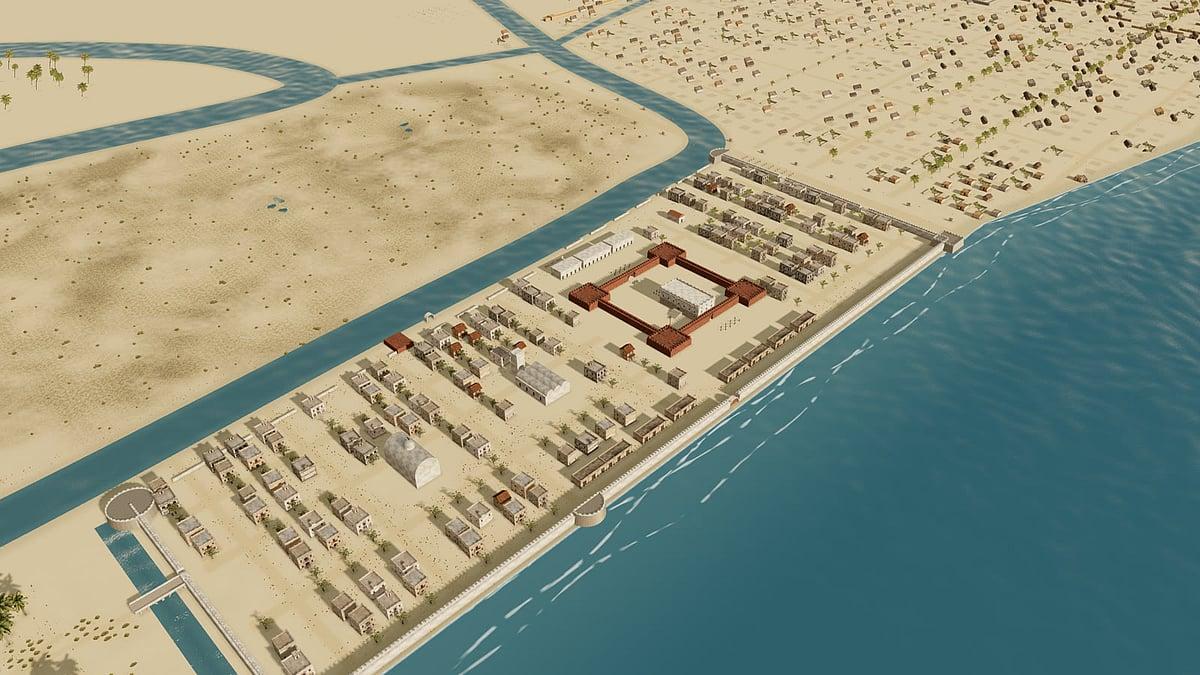
The coded output starts in 2D, is converted to 3D in Blender, and is then rigged with digital skeletons. The resulting environment recreates fishermen's settlements, the East India Company's establishment, daily life and trade.
Chandrasekaran said he has spent close to $2,000 on assets such as a house, a courtyard, a godown and a middle-class British home. In two months, he has collected and generated around 130 GB of data.
The Madras Project offers three vantage points: the coast, the Fort and the town. Users can choose to interact with villagers, British residents or people living near the Fort, step inside the artillery, or examine strategies used to manage the waves, with the aim of letting people role-play life in that era.
An Open Model for Other Cities
Chandrasekaran is now building a pipeline so that other people and cities can take part. He argues that projects like this should be open source, allowing anyone to create similar experiences for their own cities, temples, churches and mosques.
For founders and technologists, the project offers a practical example of pairing generative AI with human verification and conventional code. It also points to a growing opportunity in digital heritage, where accuracy and sourcing may matter as much as visual polish in an online landscape crowded with unverified content.
Source: The New Indian Express