- By JeffkomStory Team
- Published on
A Beginner’s Guide to Mastodon: The Open-Source Twitter Alternative
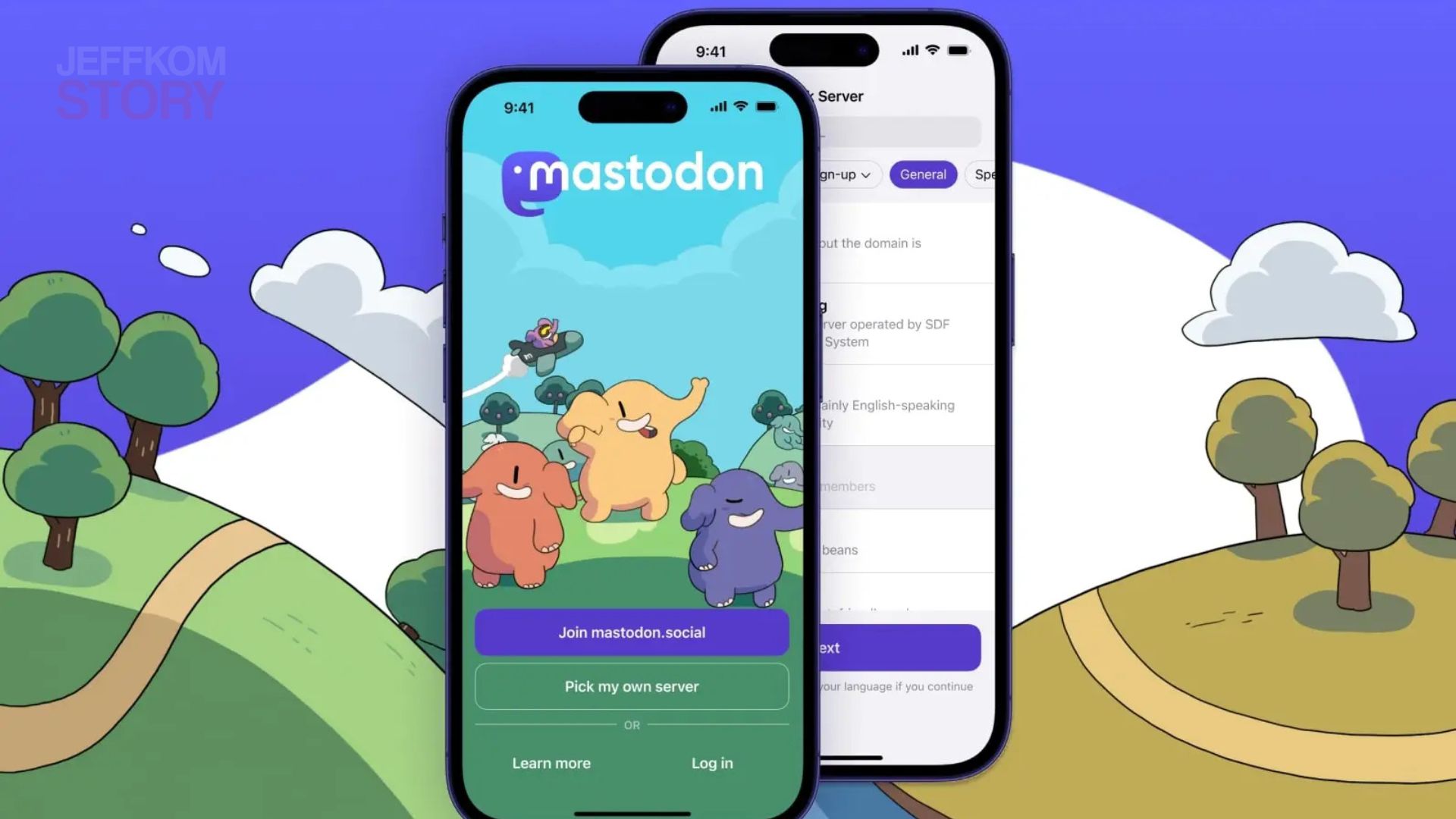
When Elon Musk acquired Twitter and rebranded it as X, many users began looking for alternatives. One name quickly surfaced: Mastodon. While newer platforms like Bluesky and Threads also gained attention, Mastodon stood out because it wasn’t new. Founded in 2016, Mastodon had already spent years building a distinct identity as a decentralized, open-source social network.
This guide breaks down what Mastodon is, how it works, and whether it might be right for you — in simple, easy-to-understand terms.
What Is Mastodon?
Mastodon is a microblogging platform created in 2016 by German software developer Eugen Rochko. Unlike Twitter/X, Facebook, or Instagram, Mastodon is run as a nonprofit. That means it’s designed to serve the public interest rather than shareholders or advertisers.
At first glance, Mastodon looks similar to Twitter. You post short messages, follow people, reply, boost (retweet), and use hashtags. But behind the scenes, Mastodon works very differently.
How Mastodon Works: Decentralization Explained
Mastodon is decentralized, meaning there is no single company controlling the entire platform.
Instead, Mastodon is made up of thousands of independent servers, also called instances. Think of it like email:
- You might use Gmail
- Someone else might use Yahoo
- You can still email each other
Mastodon works the same way.
When you create an account, you choose a server. Your username will look like this:
@yourname@servername.social
Even though you join one server, you can still follow and interact with users on other servers — unless a server has chosen to block another due to moderation issues.
Mastodon Terminology You Should Know
Here are a few common Mastodon terms explained simply:
- Instance: Another word for a server or community
- Fediverse: A network of interconnected, decentralized social platforms
- Toot: An older term for a post (most people now just say “post”)
- Boost: Mastodon’s version of a retweet
Mastodon supports replies, boosts, favorites, bookmarks, hashtags, and — as of 2025 — quote posts.
Choosing a Mastodon Server
Each Mastodon server is independently run and has its own:
- Rules
- Moderation policies
- Signup requirements
Some servers are open to everyone. Others are invite-only or require approval. For example, a science-focused server may ask for proof that you work in research.
Don’t stress too much about choosing the “perfect” server. You can move your account later if you want, and you can follow anyone regardless of which server they’re on.
To make signups easier, Mastodon now offers a default option: mastodon.social, which works well for beginners.
Can You Talk to People on Other Servers?
Yes.
You can:
- Follow users on other servers
- Reply to their posts
- Boost their content
To follow someone on another server, you’ll need to search for their full username (@name@server) from your own server’s search bar.
Understanding Mastodon Timelines
Mastodon has three main timelines:
- Home: Posts from people you follow
- Local: Public posts from users on your server
- Federated: Public posts from across the Fediverse that your server connects to
You can also enable Slow Mode to reduce information overload.
Moderation on Mastodon
There is no universal moderation policy.
Each server sets its own rules, enforces them independently, and decides which other servers to block or allow. This gives users more choice — but also means you should read a server’s guidelines before joining.
Mastodon vs Twitter/X: Key Differences
Drawbacks of Mastodon
- Much smaller user base than X
- Less intuitive for beginners
- No central authority or “global” timeline
Benefits of Mastodon
- Not owned by a single billionaire or corporation
- Open-source and community-driven
- Customizable moderation and content rules
- Smaller communities enable more meaningful conversations
Is Mastodon Safer Than Twitter?
Mastodon’s safety depends on the server you choose.
Some servers have strict anti-harassment rules and strong moderation. Mastodon also limits harassment by design:
- You can only search posts by hashtags, not random keywords
- Posts are harder to dogpile without tagging
You can still search your own posts, mentions, boosts, and favorites.
Media Support on Mastodon
Mastodon supports:
- Images (up to 4 per post, 8MB total)
- Video and audio (up to 40MB)
- Polls
It does not support features like live audio rooms or precise location tagging.
Posting Privacy Options
When you post, you can choose who sees it:
- Public: Visible to everyone
- Unlisted: Public, but not promoted in discovery
- Followers-only: Visible only to followers
- Mentioned users only: Private replies
Direct messages are simply posts with restricted visibility.
Verification on Mastodon
There is no global verification system.
However, you can self-verify by linking your website to your Mastodon profile using a special attribute (rel="me"). Some servers also offer playful verification badges, but they carry no official weight.
Is Mastodon Here to Stay?
As of mid-2025:
- Under 1 million monthly active users
- Around 10 million registered accounts
That’s tiny compared to X. But Mastodon isn’t trying to be the world’s main digital town square. It’s designed for niche communities, shared interests, and healthier online conversations.
Can You Cross-Post From Twitter/X to Mastodon?
Yes. Several third-party tools allow cross-posting, including:
- Moa Party
- Mastodon Twitter Crossposter
You can also use tools like Fedifinder or Debirdify to find your Twitter friends on Mastodon.
Does Mastodon Work With Bluesky or Threads?
- Bluesky: No. It uses its own protocol and does not support ActivityPub.
- Threads: Partial and evolving support, depending on Meta’s decisions.
Final Thoughts
Mastodon isn’t for everyone.
If you want a massive audience and real-time global trends, X may still feel familiar. But if you value open-source technology, community-driven moderation, and more intentional conversations, Mastodon is worth exploring.
In the end, Mastodon offers something rare in modern social media: choice. And that alone makes it different.
Here are some related articles you may find interesting:
Google Trends Explore Gets Gemini AI Upgrade: Smarter Trend Discovery for Creators
Google has introduced a major upgrade to its Trends Explore page, adding powerful Gemini AI capabilities...
Robotaxis Get Green Light in New York, Except in New York City
New York is taking a major step toward the future of transportation. Governor Kathy Hochul has announced...
Hands-On With Bee: Amazon’s New AI Wearable That Records, Remembers, and Reflects Your Day
Amazon is stepping into the AI wearable space with Bee, a compact device designed to record conversations,...
Nuclear Startups Are Back in Vogue: Small Reactors, Big Ambitions, Bigger Challenges
The nuclear industry is quietly entering a new renaissance. After decades of stagnation, aging plants...
Anthropic Expands Enterprise AI Footprint With Allianz Partnership
Anthropic is rapidly strengthening its position in the enterprise AI market. The latest proof is a new...
Where VCs Think AI Startups Can Win Even With OpenAI in the Game
In recent years, AI startups have lived under a looming question: How do you compete when OpenAI, Meta,...
Meta’s $2B Manus Acquisition Sparks Regulatory Divide Between Washington and Beijing
Meta’s $2 billion acquisition of AI assistant platform Manus has quickly turned into a geopolitical case...
Narwal Adds AI to Robot Vacuums to Monitor Pets, Find Jewelry, and Clean Smarter
At CES 2026, robot vacuum maker Narwal introduced a new generation of smart vacuum cleaners powered by...
Nvidia’s AI Empire: The Biggest Startup Bets of 2026 and the Game Behind the Game
Nvidia is no longer just a chip company. In 2026, it is rapidly becoming the backbone of the global AI...
A Beginner’s Guide to Mastodon: The Open-Source Twitter Alternative
When Elon Musk acquired Twitter and rebranded it as X, many users began looking for alternatives. One...
Popular Posts

Google Trends Explore Gets Gemini AI Upgrade: Smarter Trend Discovery for Creators
JeffkomStory Team
Google has introduced a major

Robotaxis Get Green Light in New York, Except in New York City
JeffkomStory Team
New York is taking a

Hands-On With Bee: Amazon’s New AI Wearable That Records, Remembers, and Reflects Your Day
JeffkomStory Team
Amazon is stepping into the

Nuclear Startups Are Back in Vogue: Small Reactors, Big Ambitions, Bigger Challenges
JeffkomStory Team
The nuclear industry is quietly
Join Our Newsletter
Start your day with impactful startup stories and concise news! All delivered in a quick five-minute read in your inbox.