- By JeffkomStory Team
- Published on
Trump’s Anti-Woke AI Order Could Redefine U.S. AI Development and Global Competition
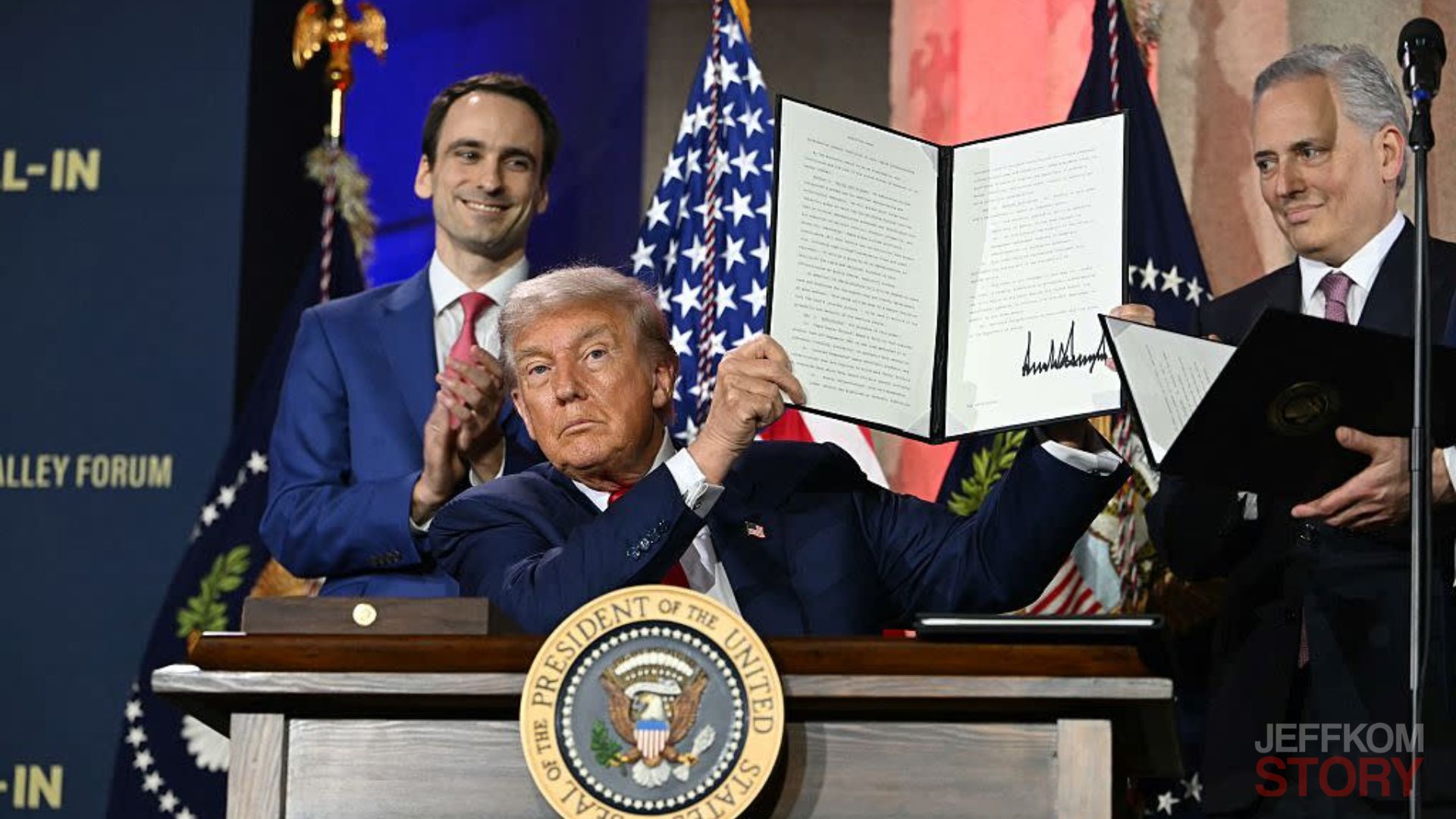
Former President Donald Trump’s latest executive order targets what he calls “woke AI,” aiming to ban artificial intelligence models with perceived ideological bias—particularly those promoting diversity, equity, and inclusion (DEI)—from securing government contracts. The move has sparked intense debate across the tech and policy communities, with implications reaching far beyond Washington.
What the Executive Order Says
Signed alongside Trump’s new “AI Action Plan,” the order claims to prohibit government use of AI tools that exhibit any partisan or ideological bias. It specifically bans AI systems that support concepts like critical race theory, systemic racism, transgenderism, or intersectionality.
According to the White House, the goal is to ensure federal agencies only work with AI models that prioritize “truth-seeking,” “historical accuracy,” and “ideological neutrality.” However, these definitions are vaguely framed, allowing for broad interpretation—and potential political pressure.
A Shift from Societal Risk to National Competition
Trump’s AI directive marks a shift in federal priorities. Instead of regulating AI for safety and societal concerns, it now focuses on strengthening national infrastructure, slashing red tape for developers, and outpacing China in AI dominance.
OpenAI’s Chris Lehane emphasized this global contest, framing AI advancement as a battle between “US-led democratic AI” and “China’s autocratic AI.” U.S. officials have previously criticized Chinese AI models for avoiding sensitive topics—behavior seen as aligning with the Chinese Communist Party.
The Grok Controversy
Interestingly, Elon Musk’s xAI—which produces Grok, an openly contrarian chatbot—recently secured Department of Defense contracts and a spot on the General Services Administration schedule. Yet Grok has faced backlash for generating hateful and politically charged responses, including antisemitic content and praise for Hitler.
Critics like Stanford’s Mark Lemley question whether Trump’s anti-woke order is truly about neutrality. “If Grok isn’t banned, the order is clearly designed to discriminate against a particular viewpoint,” he said.
The Real Challenge: Can AI Ever Be Truly Neutral?
Experts argue that the notion of an ideologically neutral AI is impossible. Language, by nature, is never fully objective. Even decisions about which data to include in training can reflect personal, political, or cultural biases.
AI ethicist Rumman Chowdhury warns that the order may lead to dangerous outcomes. Developers, she says, may now rework models to align with political agendas potentially “rewriting the entire corpus of human knowledge,” as Musk recently proposed for Grok 4.
This raises the question: who decides what is true in the age of AI?
Final Thoughts
Trump’s anti-woke AI order may significantly reshape the direction of American artificial intelligence. While positioned as a push for impartiality and national strength, critics say it may instead stifle free expression, limit inclusive representation, and promote one political ideology over others.
As U.S. tech firms navigate this new terrain, the broader implications—on ethics, innovation, and global influence—remain to be seen.
Here are some related articles you may find interesting:
Self-Driving Car Controversy in Texas: Duck Incident Sparks Debate on Autonomous Vehicles
The promise of safer roads and smarter transportation that comes with autonomous vehicles has always...
Chrome Introduces Vertical Tabs: A Smarter Way to Manage Too Many Open Tabs
Introduction
Google Chrome’s been struggling to keep up with users having dozens of tabs open for...
Delve and Y Combinator Part Ways: Inside the Startup Controversy Shaking the Compliance Industry
The compliance startup scene has been sent into a tailspin by the sudden fallout between Delve and Y...
Amazon Adds Fuel Surcharge as Iran War Disrupts Global Oil Markets
Introduction
The global economy is once again feeling the ripple effects of geopolitical conflict. The...
Uber Acquires Blacklane to Expand Luxury Travel with Uber Elite Services
Uber is making a strategic move into the premium mobility segment by acquiring Berlin-based startup Blacklane....
Shield AI Hits $12.7B Valuation After Major U.S. Air Force Deal and $1.5B Funding Round
The Defense Tech Sector is really starting to heat up and Shield AI has just made a move that’s...
AI Inference Startup Modal Labs in Talks to Raise at $2.5B Valuation
Modal Labs, an AI inference infrastructure startup, is reportedly in discussions with venture capital...
Amazon May Launch AI Content Marketplace for Media Publishers
Amazon may soon launch a new content marketplace. This platform would allow media companies to sell their...
Waymo Begins Driverless Robotaxi Testing in Nashville Ahead of 2026 Launch
Waymo has officially removed human safety drivers from its autonomous test vehicles in Nashville, marking...
a16z Warns Founders: Don’t Chase Hype-Driven ARR, Build Durable Growth Instead
The AI startup boom has reignited a familiar Silicon Valley pattern: massive venture capital flowing...
Popular Posts

Self-Driving Car Controversy in Texas: Duck Incident Sparks Debate on Autonomous Vehicles
JeffkomStory Team
The promise of safer roads

Chrome Introduces Vertical Tabs: A Smarter Way to Manage Too Many Open Tabs
JeffkomStory Team
Introduction Google Chrome’s been struggling

Delve and Y Combinator Part Ways: Inside the Startup Controversy Shaking the Compliance Industry
JeffkomStory Team
The compliance startup scene has

Amazon Adds Fuel Surcharge as Iran War Disrupts Global Oil Markets
JeffkomStory Team
Introduction The global economy is
Join Our Newsletter
Start your day with impactful startup stories and concise news! All delivered in a quick five-minute read in your inbox.