A government-backed accelerator in southeastern China has wrapped up its latest cohort of deep-technology startups, closing with a day of investor pitches and industry matchmaking in Xiamen.
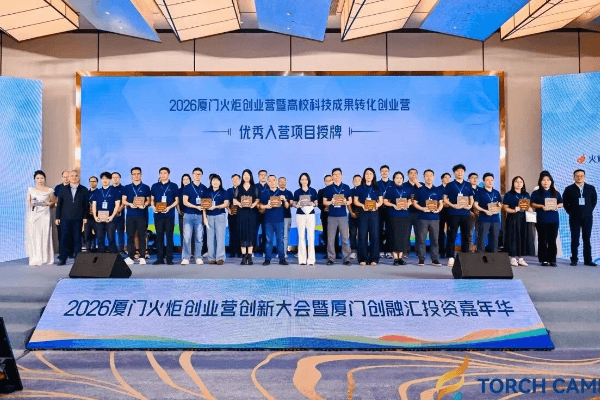
The 2026 Xiamen Torch Startup Camp concluded on November 21 at the Xiamen Fliport Convention and Exhibition Center, according to a report by 36Kr Europe. The program is run by the Xiamen Torch High-Tech Industrial Development Zone under the guidance of the Torch High Technology Industry Development Center, part of China's Ministry of Industry and Information Technology.
An Upgraded Program Built on Six Prior Years
This year marked the seventh session of the camp, which is also known as the Startup Camp for University S&T Achievements Commercialization. Its organizers describe it as a flagship effort to turn laboratory research into viable companies.
The program draws on six years of earlier operating experience from Xiamen High-Tech Investment. In 2026, with national-level backing, it was overhauled and added to the Torch S&T Achievements Expressway, a branded series of events focused on commercializing research.
Organizers said the redesign centered on two priorities: a rebuilt, practice-oriented curriculum and stronger links to investors. Both are aimed at a familiar complaint among early hard-tech founders, who often lack business know-how, funding channels and industry contacts.
From 341 Applicants to 40 Finalists
Recruitment opened in May and attracted 341 applications from 59 cities and regions in mainland China and abroad, including entries from Hong Kong, Macao and Taiwan. Core team members came from more than 200 universities and research bodies, among them Tsinghua University, Peking University, the Chinese Academy of Sciences, Harvard Medical School, the University of Cambridge and Imperial College London.
The projects spanned new energy, new materials, intelligent sensing and semiconductors, advanced manufacturing, biomedicine, artificial intelligence, embodied intelligence, ocean technology and hydrogen energy.
After online screening and four selection roadshows held in Beijing, Shanghai and Xiamen between August and September, 40 projects were admitted. Rather than offering broad support to many applicants, the camp deliberately concentrated on a small group of early and mid-stage ventures.
A Curriculum Focused on Money and Management
Training ran in three stages from October to November, structured around a seven-day intensive acceleration format. Sessions covered business model clarity, pitch deck refinement, presentation skills, regulatory compliance for hard-tech firms and access to industrial partners.
Yao Binxing, a partner at RSM China, spoke on financial and tax management for young companies. He encouraged founders to treat financial statements as an operating dashboard, balance cash flow with profitability, and move toward legally compliant tax planning, outlining a five-stage roadmap for upgrading finance functions.
Cui Lin, a partner at ClearVue Partners, addressed team decision-making. He argued that disagreement within founding teams is less dangerous than having no agreed way to resolve it, recommending that tactical calls be delegated to executives while strategic decisions rest with the CEO. He also cautioned against equal equity splits and co-CEO arrangements.
Mentoring, Site Visits and Corporate Meetings
Founders including Hong Fei, vice president of Zhenyi Medical, and Zhang Xinghua, chairman of YuanNeng Technology, shared their own experiences on equity design, tax compliance and capital strategy. Venture investors and industry specialists also held closed-door one-on-one sessions to review each team's technology, business model and fundraising plans.
Participants visited the School of Intelligent Manufacturing at Xiamen University, Jiageng Laboratory and Xiang'an Laboratory to discuss research partnerships and talent recruitment. They also met with listed companies such as Double Medical Technology, Inovance Technology, Hengdian East Magnetics and Sinobioway Medicine to test their technical direction against real industrial needs.
Closing Conference Brings Investors to the Table
The closing ceremony doubled as the 2026 Xiamen Torch Startup Camp Innovation Conference, which brought together representatives from nearly 100 investment and industrial institutions. An exhibition area displayed prototypes and technical solutions from the cohort, and venture investors gave keynotes on investment prospects in hard tech.
All 40 projects took part in two rounds of roadshow competition before investors and industry partners. Three were selected to receive a Most Growth Potential Award, though the source did not name the winning teams.
What the Model Signals for Hard-Tech Founders
The camp reflects a broader push by Chinese local governments to keep research-driven startups close to home by bundling training, capital introductions and access to industrial supply chains. Organizers said the zone plans to keep expanding a tiered support system for science-based companies.
For founders working on capital-intensive technologies, the program's emphasis on governance, tax compliance and investor readiness highlights where many technically strong teams still fall short. Whether these 40 projects convert their exposure into funding and local operations will be the real measure of the model's success.
Source: eu.36kr.com