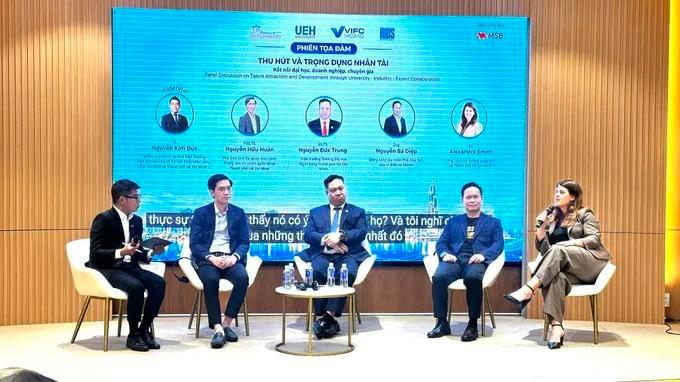
The Vietnam International Financial Center in Ho Chi Minh City (VIFC-HCMC) has launched a dedicated academy to develop the skilled workforce it says the project needs to compete with established financial hubs.
The VIFC Academy was unveiled on November 14 at a scientific conference on attracting and using talent in financial technology and artificial intelligence, according to a report by SGGP English Edition. The event was co-organized with the University of Economics Ho Chi Minh City (UEH) and the Ho Chi Minh City Institute for Development Studies (HIDS).
A Conference Focused on Fintech and AI Talent
The gathering brought together Truong Minh Huy Vu, Vice Chairman of the Ho Chi Minh City People's Committee, alongside officials from city departments, research institutes, universities and fintech companies.
Speakers examined the talent question from three angles: building stronger links between universities and businesses, the demand for fintech and AI specialists combined with training led by enterprises, and lessons from international experience in workforce development.
Workforce Gaps Emerge After Nearly a Year of Operations
Associate Professor Nguyen Huu Huan, Vice Chairman of the VIFC-HCMC Executive Agency, said that close to one year of running the center had revealed several shortfalls in human resources.
Because the idea of an international financial center is still fairly new in Vietnam, he noted, most universities have not yet adapted their curricula to match. Workforce programs are underway, but only a small number of employees currently hold international professional certifications.
Huan argued that without staff who meet international standards, the center would struggle to compete with its global peers. Building high-quality human resources is therefore a central priority, especially during the center's early stage.
Universities Under Pressure to Adapt
Associate Professor Bui Quang Hung, President of UEH, framed the challenge in competitive terms, saying Ho Chi Minh City is now in a contest for talent with other international financial centers in the region.
To keep pace, he said, higher education institutions must make significant changes. These include pooling resources, moving toward interdisciplinary programs and encouraging lifelong learning rather than treating education as a one-time stage.
What the VIFC Academy Will Do
The academy is designed to act as a connector between stakeholders, helping pinpoint workforce requirements that can then shape training, coaching and research programs.
For the 2026 to 2030 period, it will concentrate on three functions. The first is internal training to strengthen the capabilities of staff within the Executive Agency.
The second is external training for members, organizations, investors and the future talent pipeline. The third is research and consulting work intended to supply evidence-based arguments and practical solutions supporting the center's development and operations.
Why Talent Matters for Financial Hubs
International financial centers depend heavily on specialized professionals, from regulatory and compliance experts to engineers building payment and trading systems. As fintech and AI reshape financial services, the mix of skills required is becoming more technical.
By pairing a training institution with the center itself, Vietnam is attempting to grow that expertise locally rather than relying solely on importing it.
What It Means for Founders and the Fintech Sector
For fintech startups and investors watching Vietnam, the academy signals that authorities see talent, not just regulation or infrastructure, as a key constraint on the financial center's ambitions.
If the academy succeeds in aligning university output and professional training with industry needs, companies operating in Ho Chi Minh City could gain access to a deeper pool of certified, technically skilled staff. Its impact will become clearer as its programs roll out over the coming years.
Source: SGGP English Edition