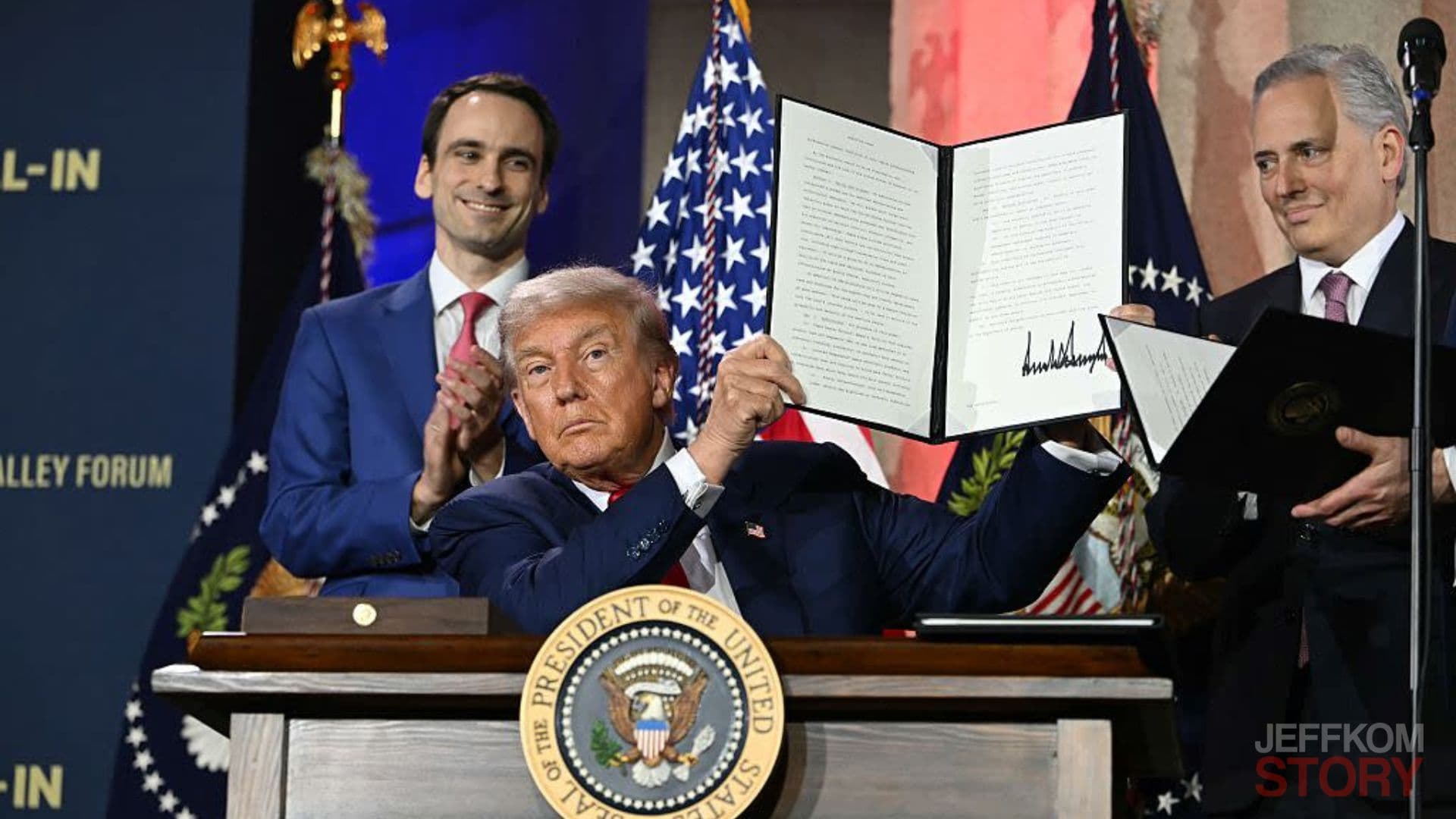
Former President Donald Trump’s latest executive order targets what he calls “woke AI,” aiming to ban artificial intelligence models with perceived ideological bias—particularly those promoting diversity, equity, and inclusion (DEI)—from securing government contracts. The move has sparked intense debate across the tech and policy communities, with implications reaching far beyond Washington.
What the Executive Order Says
Signed alongside Trump’s new “AI Action Plan,” the order claims to prohibit government use of AI tools that exhibit any partisan or ideological bias. It specifically bans AI systems that support concepts like critical race theory, systemic racism, transgenderism, or intersectionality.
According to the White House, the goal is to ensure federal agencies only work with AI models that prioritize “truth-seeking,” “historical accuracy,” and “ideological neutrality.” However, these definitions are vaguely framed, allowing for broad interpretation—and potential political pressure.
A Shift from Societal Risk to National Competition
Trump’s AI directive marks a shift in federal priorities. Instead of regulating AI for safety and societal concerns, it now focuses on strengthening national infrastructure, slashing red tape for developers, and outpacing China in AI dominance.
OpenAI’s Chris Lehane emphasized this global contest, framing AI advancement as a battle between “US-led democratic AI” and “China’s autocratic AI.” U.S. officials have previously criticized Chinese AI models for avoiding sensitive topics—behavior seen as aligning with the Chinese Communist Party.
The Grok Controversy
Interestingly, Elon Musk’s xAI—which produces Grok, an openly contrarian chatbot—recently secured Department of Defense contracts and a spot on the General Services Administration schedule. Yet Grok has faced backlash for generating hateful and politically charged responses, including antisemitic content and praise for Hitler.
Critics like Stanford’s Mark Lemley question whether Trump’s anti-woke order is truly about neutrality. “If Grok isn’t banned, the order is clearly designed to discriminate against a particular viewpoint,” he said.
The Real Challenge: Can AI Ever Be Truly Neutral?
Experts argue that the notion of an ideologically neutral AI is impossible. Language, by nature, is never fully objective. Even decisions about which data to include in training can reflect personal, political, or cultural biases.
AI ethicist Rumman Chowdhury warns that the order may lead to dangerous outcomes. Developers, she says, may now rework models to align with political agendas potentially “rewriting the entire corpus of human knowledge,” as Musk recently proposed for Grok 4.
This raises the question: who decides what is true in the age of AI?
Final Thoughts
Trump’s anti-woke AI order may significantly reshape the direction of American artificial intelligence. While positioned as a push for impartiality and national strength, critics say it may instead stifle free expression, limit inclusive representation, and promote one political ideology over others.
As U.S. tech firms navigate this new terrain, the broader implications—on ethics, innovation, and global influence—remain to be seen.