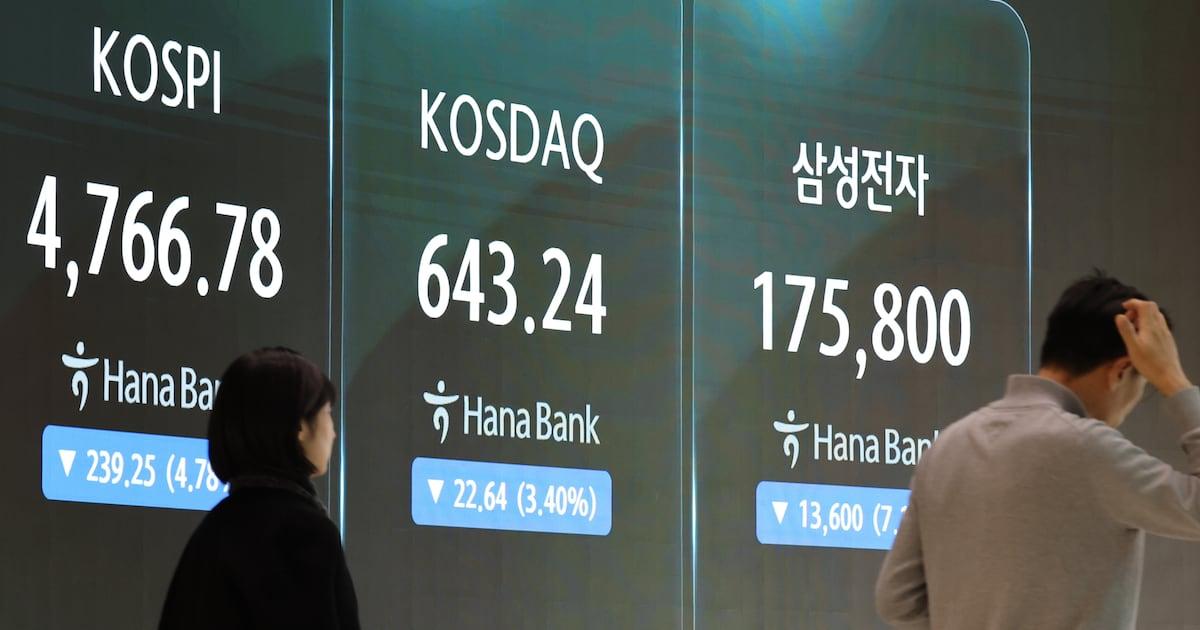
Asia's biggest memory chipmakers are earning more money than ever, but their share prices are moving sharply in the opposite direction. Samsung Electronics, SK hynix and Japan's Kioxia Holdings have all seen their stock values collapse from this year's highs, even as quarterly results keep setting records.
According to a report by ChosunBiz, the disconnect has widened since the start of November, as concerns about an AI bubble in the United States and worries over interest rates spread through markets in Korea, Japan, Taiwan and the U.S. The result is a set of valuations that look unusually cheap on paper.
Steep Declines Across the Chip Sector
Samsung Electronics shares are down 54% from their peak this year, while SK hynix has fallen 65%. Kioxia, the Japanese NAND flash maker, has dropped 79% from its high.
The sell-off extends beyond memory specialists in Korea and Japan. Micron in the United States is down 52% from its peak, and Taiwan's TSMC has slipped 21%.
Record Earnings Tell a Different Story
The declines contrast with surging profits. Samsung reported third-quarter operating profit of about 107.4 trillion won, up 783.1% year over year, while SK hynix earned roughly 83.3 trillion won, a 632% increase.
Kioxia's and Micron's latest quarterly operating profits reached 23.2 times and 12 times their year-earlier levels, respectively, and TSMC grew operating profit by 75%. Forecasts compiled by CompanyGuide point to further gains in 2027, with Samsung and SK hynix expected to lift operating profit by 61% and 64% from this year's estimates.
Valuations Fall to Unusually Low Levels
Data from FnGuide put the 12-month forward price-to-earnings ratios of Samsung and SK hynix at 2.39 and 2.01, meaning their market values are only around twice their expected net profit for the next year. Kioxia's forward ratio stands at 2.48.
By comparison, TSMC trades at a forward multiple of 15.26 and Micron at 3.62. An analysis of Bloomberg data by South African asset manager Fairtree found that Samsung, SK hynix and Micron together were valued at about four times projected 2027 profit, roughly one-fifth of the multiples applied to groups such as Nvidia, Broadcom and TSMC, or Microsoft, Alphabet, Meta and Amazon.
Why Investors Are Looking Past 2027
Analysts point to doubts over whether massive AI infrastructure spending will generate matching returns, along with the possibility of further U.S. rate hikes, limits on data center construction and export controls on chips bound for China. There are also concerns that capacity expansion by memory makers could eventually produce a supply glut.
Choi Bo-young of Kyobo Securities noted that SemiAnalysis has cut its 2028 forecasts for accelerator spending by 28% and for high-bandwidth memory bit demand by about 30%, while TrendForce expects AI server shipment growth to slow to around 10% that year. Choi also anticipates pressure on NAND prices and margins.
Selling pressure has been amplified by market mechanics. Foreign investors sold a net 18.979 trillion won of Samsung shares and 43.224 trillion won of SK hynix shares between July 1 and the 25th of this month, with portfolio rebalancing and hedge fund deleveraging cited as contributors.
The Cyclical Valuation Trap
Some market watchers caution that a low earnings multiple can be misleading in a cyclical business like semiconductors. During booms, profits swell and ratios shrink, but new supply can later erode earnings, which is why the industry also leans on price-to-book ratios as a steadier gauge.
Mok Dae-kyun, CEO of KCGI Asset Management, said concerns about 2028 earnings began surfacing in the first half of the year and that slowing growth alone can weigh on stocks. He added that the main difficulty is that nobody knows where the market bottom lies.
What the Divide Means for the Industry
Not every analyst sees the sell-off as justified. Kim Dong-won, head of research at KB Securities, argued that current prices already reflect much of the worry about memory prices peaking in 2027 and 2028, and expects a rebound as demand is confirmed.
For hardware founders and investors, the episode highlights how quickly sentiment can detach from fundamentals in a capital-intensive sector. The key signals to watch will be AI infrastructure spending plans, memory supply additions and whether 2028 demand forecasts continue to shift.
Source: Chosunbiz