Manufacturers have long struggled to know exactly when a cutting tool is wearing out. Replace it too early and money is wasted; wait too long and part quality, machine health and worker safety can suffer.
A team of researchers now proposes splitting the job between cloud servers and edge devices on the shop floor. Their framework, described in the journal Discover Applied Sciences, aims to identify the wear state of milling tools in real time, even when machining conditions change.
According to a report by Bioengineer.org, the system reached an average classification accuracy of about 75 percent across a series of cross-condition tests, with real-time inference cited at around 0.3 seconds.
Why Tool Wear Monitoring Matters
Milling tools degrade gradually as they cut metal, and that degradation directly affects the precision of finished parts. Continuous monitoring helps factories maintain quality standards and avoid unexpected failures that can halt production.
The difficulty is that wear behaves differently depending on cutting speed, feed rate and other variables. A model trained under one set of conditions often performs poorly under another, which is the central problem this research tries to address.
Building the Dataset From Vibration and Images
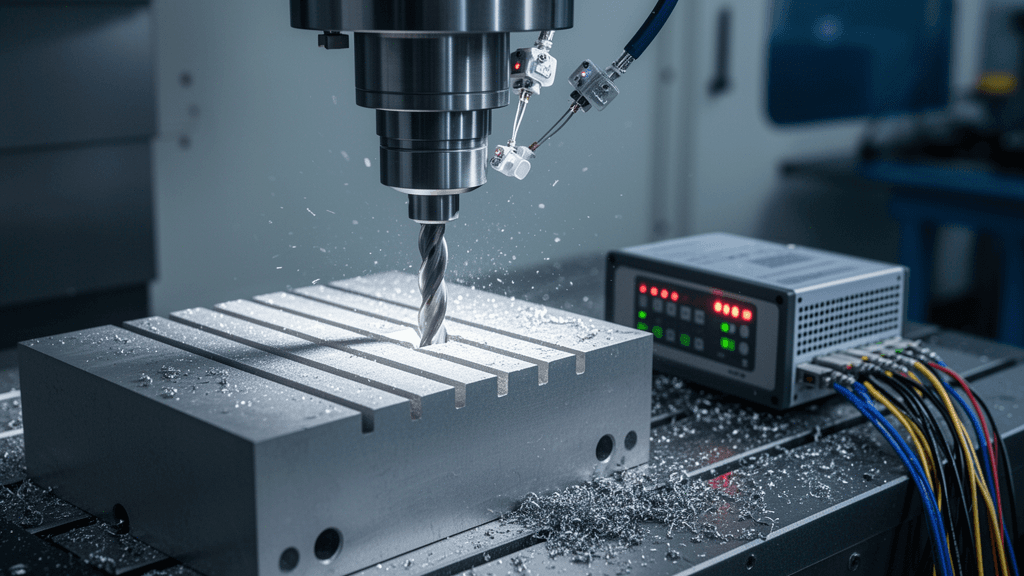
The researchers ran milling experiments under 54 distinct cutting conditions. During each run, they recorded spindle vibration along three axes and captured images of the tool's flank face.
The vibration signals were converted into frequency-domain samples. Each sample was then labeled by wear stage, using flank wear width measured from the matching images.
Four stages were defined in sequence: initial wear, steady wear, rapid wear and fracture failure. This gave the models a clear progression to learn from.
How the Edge-Cloud Architecture Works
The framework uses three neural network models distributed between the cloud and the edge. In the cloud, a pretrained model based on a variational autoencoder learns general patterns in the vibration signals.
A second cloud model adds a spatial attention module and is fine-tuned on labeled data from known source conditions. An edge model then performs local transfer learning and makes the final wear-state classification close to the machine.
The approach follows a transductive transfer-learning setup. Unlabeled data from the new target conditions are used during pretraining, while task-specific fine-tuning relies only on labeled source data.
What the Results Show
Across eight transfer tasks, each moving the model from one set of cutting conditions to another, target-domain accuracy ranged from 53.7 percent to 88.3 percent. The overall average came to roughly 75 percent.
The team also compared several transfer methods and found that transfer component analysis delivered the highest accuracy among the approaches tested.
Ablation experiments, which remove individual components to measure their impact, indicated that the autoencoder pretraining, the source-domain fine-tuning and the spatial attention module each contributed meaningfully to performance.
The Case for Splitting Work Between Cloud and Edge
The design reflects a broader pattern in industrial computing. Heavy model training and general representation learning happen in the cloud, where computing resources are plentiful, while time-sensitive decisions are made at the edge, near the equipment.
This division can reduce latency and limit how much raw sensor data needs to travel over a network, both of which matter for factories that want fast alerts without constant cloud round-trips.
What It Means for Industrial Tech Builders
The wide spread in accuracy across tasks suggests the method is not yet ready to replace human judgment on every production line. Still, the study offers a concrete blueprint for adapting predictive maintenance models to changing conditions without fully relabeling new data.
For startups and vendors working on industrial IoT, predictive maintenance or edge AI, the research reinforces a practical lesson: combining cloud-scale learning with local inference may be the most realistic path to monitoring tools that work across the messy variety of real manufacturing environments.
Source: Bioengineer.org