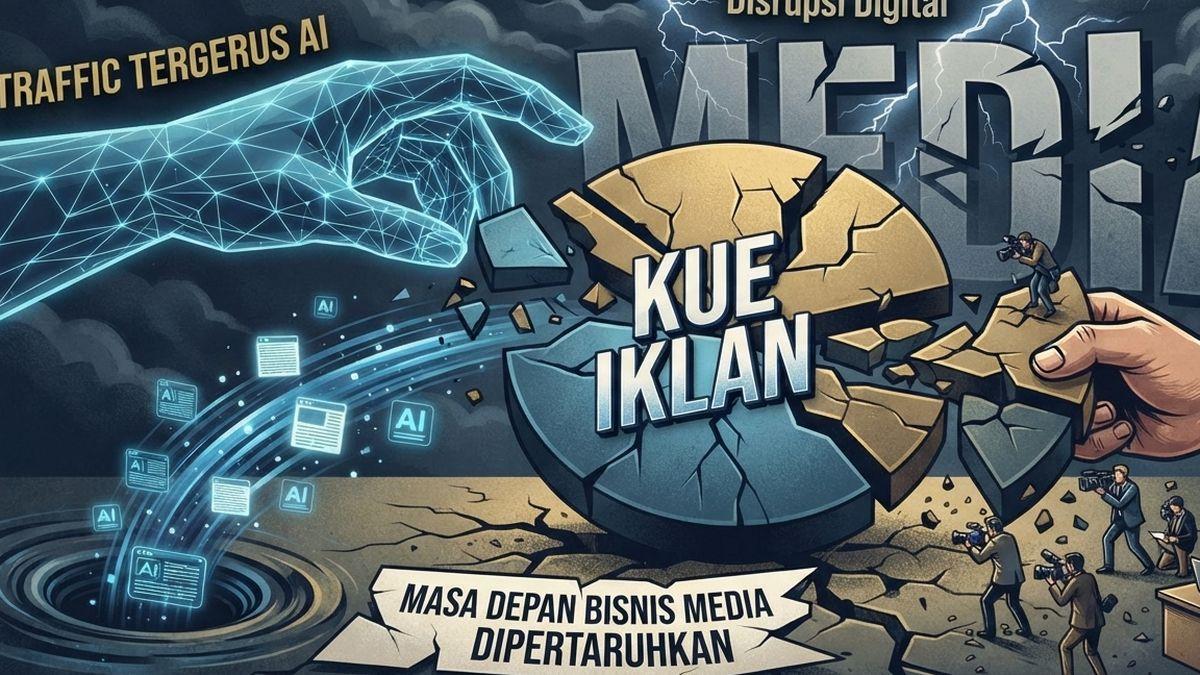
Indonesia's news industry is being squeezed from two directions at once, according to the country's Press Council. Digital platforms dominate the advertising market, and generative AI is drawing readers away from publishers' own websites.
The council laid out its concerns before the Legislative Body (Baleg) of the Indonesian House of Representatives on Wednesday, November 11, 2026. It warned that the current situation threatens the survival of the press and is already contributing to job losses across the sector, according to a report by Kompas.com.
Platforms Take the Bulk of Digital Ad Spending
Dahlan Dahi, who chairs the Press Council's Digital and Sustainability Commission, cited Wavemaker 2025 figures showing that platforms capture 80 percent of digital advertising in Indonesia.
That leaves only 20 percent for media companies and publishers. According to Dahlan, that remaining slice is now divided among more than 50,000 media businesses in the country.
Fragmentation on that scale means individual outlets are competing for very small amounts of revenue, which makes it hard to fund newsrooms over the long term.
Layoffs Signal Deeper Strain
Dahlan said the press faces serious difficulty surviving under these market conditions. "This is an unsustainable condition," he told lawmakers.
He pointed to the thousands of layoffs in the media industry as one consequence of the revenue squeeze. He added that the short-term outlook is also challenging.
Generative AI Cuts Publishers Out of the Loop
On top of advertising pressure, the council highlighted the effect of generative AI tools, which have spread widely since November 2022. Dahlan said traffic and page views at media outlets have dropped by as much as 70 percent since then.
He described a new pattern in how people get information. In the past, users went to platforms, and platforms sent traffic on to publishers. Now, with AI-generated answers, the exchange often ends between the user and the platform, and the publisher no longer appears in the chain.
Dahlan also raised concerns that journalistic work is being consumed by AI systems without payment, a situation he called dangerous for the information ecosystem.
Calls for Antitrust Enforcement
The Press Council is urging authorities to apply anti-monopoly rules alongside protections for journalistic work. Dahlan argued that if platforms gain monopoly power, both media companies and the wider public stand to lose.
He said he hoped platforms would not use their dominant position in ways that damage the public information ecosystem.
Pushing for Stronger Compensation Rules
Press Council Deputy Chairman Totok Suryanto told lawmakers that rules on economic rights and compensation are essential to protect mass media. He drew on experience with Presidential Regulation No. 32 of 2024, which addresses platform responsibilities toward publishers but has seen low compliance from platforms.
The council proposed that compensation payments should not rely only on Collective Management Organizations (LMK). Instead, it wants the framework to also allow business-to-business deals directly between platforms and media companies.
What the Debate Means for Media and Tech
Indonesia's discussion reflects a wider global question about how news organizations get paid when platforms and AI tools sit between them and their audiences. Similar debates over compensation and market power have played out in several countries.
For media founders and executives, the message is that advertising alone may not sustain a crowded market, and that policy outcomes on platform payments could shape business models. For platforms and AI developers, the hearing signals growing pressure in Indonesia to share value with the publishers whose content they rely on.
Source: Kompas.com