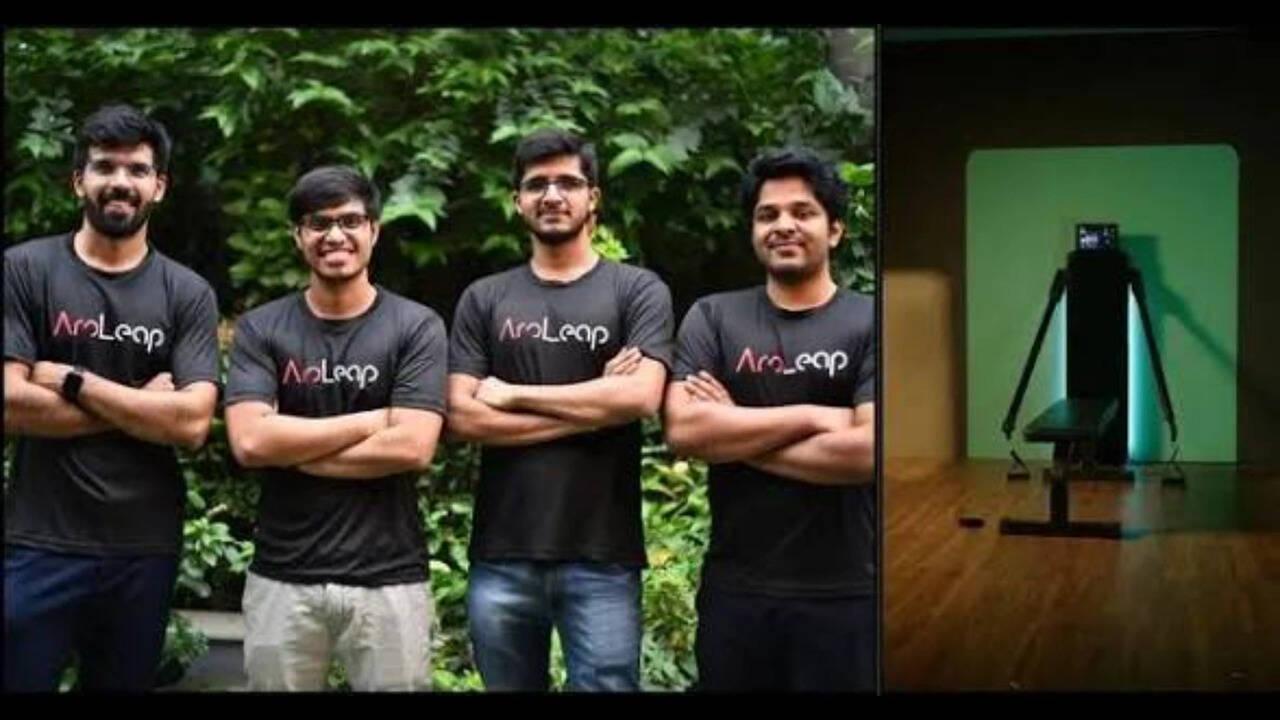
A Bengaluru startup founded by four graduates of IIT Delhi is betting that the future of home fitness fits on a single wall. Their product, Aroleap X, replaces stacks of weight plates with motors that generate resistance, packing a strength-training setup into a space roughly the size of a wall-mounted television.
The device has earned public praise from industrialist Anand Mahindra, who has suggested it could find buyers far beyond India. That attention raises a familiar challenge for young hardware companies: turning a clever invention into something affordable and widely available.
The story of how the company got here was reported by Education Times, drawing in part on an earlier account published by The Better India.
A Shared Frustration Becomes a Business Idea
The company traces back to late 2019, when friends Aman Rai, Anurag Dani, Rohit Patel and Amal George started talking about building something together. All four were into fitness in different ways: Rai ran ultra-marathons, two of the group trained regularly at the gym, and one practised calisthenics.
The spark came from a practical problem. Rai, a chemical engineering graduate working in Bengaluru, struggled to keep up strength training while living in a rented flat with no room for bulky equipment. Dani had similar trouble fitting gym sessions around his work schedule.
Patel and George, who both had backgrounds in robotics, saw the issue as an engineering puzzle worth tackling.
Swapping Iron for Motors
Rather than relying on traditional weights, the founders set out to create resistance electronically, a concept they refer to as digital weights. Motors would do the work that plates and cables do in a conventional gym machine.
Getting there took time and money. The team built close to 15 prototypes and put around Rs 25 lakh of their own savings into development, according to The Better India.
Aroleap Fitness Private Limited was incorporated in 2020, and the founders kept working through the pandemic from their separate homes. Early versions were tested with friends and potential customers, whose feedback shaped the final design.
Winning Over an Early Backer
Convincing investors to fund an unfamiliar category of product proved to be its own hurdle. Patel reached out to Nithin Kamath, co-founder of the brokerage Zerodha.
By Rai's account, Kamath came to the founders' Bengaluru apartment, tried the prototype himself and went on to become the company's first angel investor.
The product went on sale in May 2022. It takes up about four feet by two feet of wall space, and the company later reached a broader audience through an appearance on Shark Tank India Season 3.
A Public Endorsement From Anand Mahindra
In October 2024, Mahindra posted a video of Aroleap X on X. He framed it not as a technological breakthrough but as a smart blend of mechanical design and physical therapy principles.
He also pointed to likely use cases, including small apartments and business hotel rooms, and said the product had global potential. The post gave the young company a fresh wave of visibility.
Early Traction, Modest Scale
The company has reportedly sold more than 300 units across 20 cities and posted turnover of Rs 3.5 crore in 2023-24.
Those numbers point to a steady start, but they remain small for a product being described as globally relevant. Expanding further will likely hinge on pricing, manufacturing capacity and distribution.
What Aroleap's Path Signals for Hardware Founders
Aroleap's journey illustrates a common pattern in consumer hardware: a problem drawn from personal experience, years of self-funded prototyping, and a crucial early believer willing to test the product in person.
It also shows the gap between attention and scale. High-profile praise can open doors, but the next phase will test whether a device designed around compact Indian city homes can win customers in much larger markets.
Source: Education Times