DeepX, a South Korean company that designs semiconductors for artificial intelligence, has signed a pair of cooperation agreements aimed at making its neural processing unit easier for developers and enterprises to adopt.
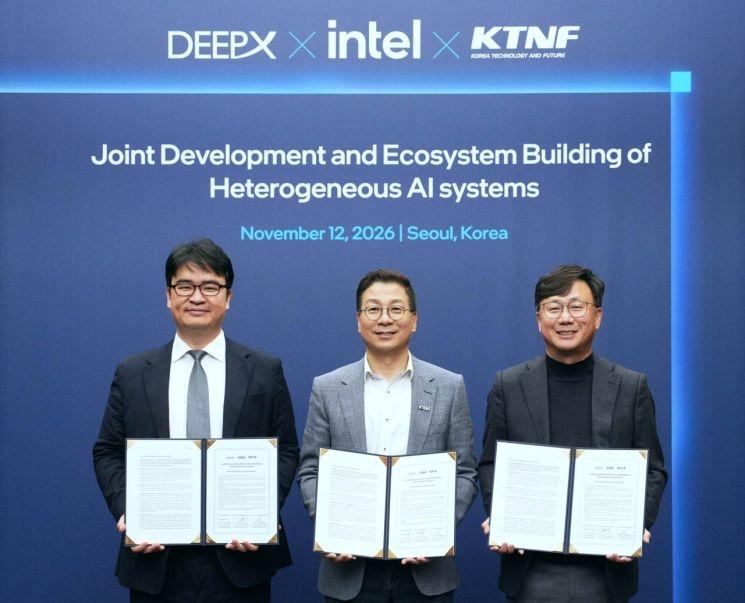
The first is a memorandum of understanding with Intel Korea focused on Intel's AI software ecosystem. The second is a three-way agreement that also brings in KTNF, a domestic server manufacturer, to examine a jointly built AI inference server for companies running AI on their own premises.
The agreements were signed on the 12th at COEX in Seoul, and DeepX announced them the following day, according to a report by Maeil Business Newspaper.
Linking DeepX's NPU With Intel's OpenVINO
At the center of the DeepX and Intel Korea deal is OpenVINO, Intel's open-source toolkit for running AI inference efficiently across a range of computing hardware. Inference is the stage at which a trained model is put to work, such as answering a question or analyzing an image.
The two companies plan to study how OpenVINO and the DeepX NPU can be connected and optimized together. That includes checking whether model conversion and the execution environment are compatible, so developers can bring existing models and tools to DeepX hardware without starting from scratch.
The goal is to reduce a familiar pain point in the chip industry: developers often have to rewrite software or change how models run for each new processor they target.
An Exploration, Not a Finished Integration
The agreement does not mean the integration is complete. It sets up a process to verify compatibility and work out optimization approaches, rather than announcing a product that is ready to ship.
The groundwork began earlier. DeepX CEO Kim Nok-won met members of Intel's OpenVINO development team in Silicon Valley in October to discuss NPU integration and the direction of AI model optimization.
Robots and Next-Generation Chips
The partnership also extends to physical AI, meaning AI systems that operate in the real world, such as robots. Under the proposed setup, Intel's x86 processors would handle system control, while the DeepX NPU would take on perception and decision-making about the robot's surroundings.
The companies intend to verify the technical feasibility of such a platform and discuss real robot demonstrations as well as broader applications.
They will also look at DX-M2, a generative AI chip DeepX is developing on Samsung Electronics' 2-nanometer process. DX-M2 is designed to run large language models and vision-language models, which interpret images and text together, at roughly 5 watts. The partners will consider using it in on-device services and dedicated corporate AI equipment.
A Three-Way Server Effort With KTNF
In a separate agreement signed the same day, DeepX, Intel Korea and KTNF will examine co-developing an AI inference server that splits workloads across different types of chips, such as NPUs and CPUs.
Each company brings a distinct piece. DeepX contributes its NPU and model optimization know-how, Intel Korea supplies CPUs, other computing devices and software, and KTNF provides server design, manufacturing and system integration.
The primary target is on-premise deployment, where companies run AI on servers housed in their own facilities rather than relying on external cloud providers. The partners plan to work on system design, software integration, and testing of real-world inference performance and compatibility.
From Proof of Concept to Customers
The three companies also plan to jointly support proof-of-concept projects for customers in South Korea and abroad. These trials are meant to confirm whether the technology works in practice and to identify paths toward commercialization.
No timeline, pricing or customer names were disclosed as part of the announcements.
What the Deals Signal for AI Chip Startups
For a young NPU maker, software compatibility can matter as much as raw chip performance. Aligning with a widely used toolkit like OpenVINO could lower the barrier for developers who might otherwise hesitate to adopt unfamiliar hardware.
The server collaboration points to another opportunity: enterprises that want to keep AI workloads in-house for cost, control or data reasons. Whether these exploratory agreements turn into shipping products will depend on the verification work and customer trials still ahead.
Source: 매일경제