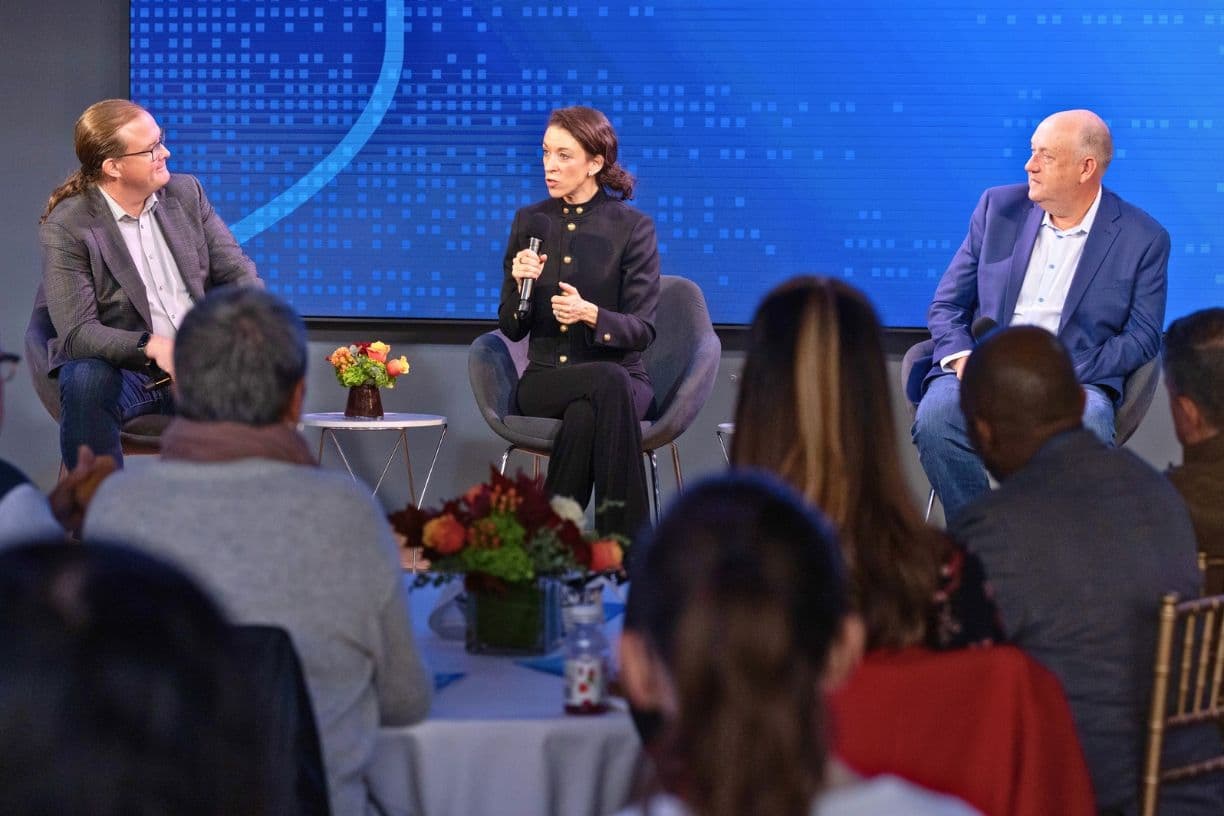
Skepticism about artificial intelligence is reasonable, according to a group of technology leaders who gathered in Boston to discuss public trust in AI. Yet the same panelists said they remain optimistic that the technology can make work and daily life more efficient, as long as people stay at the center of how it is used.
The discussion, held October 29 at WBUR CitySpace, centered on the latest Bentley-Gallup Business for Society Report, which found that many Americans do not trust businesses to deploy AI responsibly. The event was described in a report published by Bentley University.
A Panel Built Around Survey Findings on AI Trust
The event, titled The Business of AI: Opportunity, Trust and What Comes Next, brought together Tye Brady, chief technologist at Amazon Robotics; Meghan Verena Joyce, co-founder and CEO of Duckbill; and Richard Tibbetts, a former engineering manager at Anthropic. Boston Globe columnist and associate editor Shirley Leung moderated.
Bentley President E. LaBrent Chrite opened the day by urging leaders to take seriously public concerns about how AI is built and deployed. Gallup Senior Partner Stephanie Marken then walked through the survey results, noting that trust varies depending on the task, such as driving a car or supporting learning compared with recommending candidates for an employer to hire.
Roughly 60 people attended, including Bentley students, for a program that combined networking, the panel and an audience Q&A.
Job Fears Drive Much of the Distrust
According to the survey, part of the public's wariness stems from the possibility that AI could reduce the number of jobs over the next decade. The panelists did not dismiss that concern, but they argued that people will continue to play a major role as AI spreads.
Tibbetts said organizations should start by breaking a job into its component tasks and identifying which ones AI can genuinely improve. He pointed to a trader's relationships with counterparties as an example of human value that automation does not replace.
In his view, the projects that succeed are those grounded in a clear understanding of the work and its desired outcomes, along with a willingness to redesign roles so that human experts and AI share the load, with software handling repetitive drudgery.
Amazon Robotics Favors a Hybrid Model
Brady, whose work at Amazon Robotics focuses on machines operating alongside warehouse employees, echoed the idea of a blended approach. He said technology earns its place when it solves real problems, helping people work more safely and productively and giving them tools that raise the level of their profession.
He was clear that automation has limits. "There's no substitute for humans, for natural intelligence. I believe in the power of people," Brady said.
The perspective is notable coming from a company that operates one of the largest fleets of industrial robots in the world, where questions about automation and employment are frequently raised.
Keeping a Human in the Loop
Joyce argued that the burden of rebuilding trust falls on businesses. She said releasing technology without any human oversight amounts to a solution looking for a problem, rather than a tool applied to a specific need.
At Duckbill, she explained, the company sees its role as deciding on behalf of customers where AI belongs, so consumers do not have to think about it. The goal is a product that delivers everyday value, with AI used to make that value more affordable.
Young Americans Are the Most Skeptical
The survey found that most Americans aged 18 to 29 do not trust businesses to use AI responsibly, the highest share of any age group. Joyce said overcoming that skepticism requires addressing people's natural resistance to change.
She told the audience that the most valuable thing adults can pass on to children and students is a willingness to embrace change without fear, and to lead with optimism during uncertain times.
The Boston event followed an October 8 session in Washington, where Bentley hosted Microsoft's Ginny Badanes and OpenAI's Felipe Millon to discuss rising skepticism, along with a fireside chat featuring Rumman Chowdhury of Humane Intelligence.
What the Discussion Signals for Businesses and Founders
The common thread across the panel was that public trust in AI will depend less on the technology itself and more on how thoughtfully companies apply it. Clear use cases, human oversight and honest attention to job impacts emerged as recurring themes.
For founders and executives, the survey's findings on younger Americans are a reminder that the next generation of workers and customers will expect AI to prove its value. Companies that pair automation with visible human judgment may be better positioned to earn that confidence.
Source: Bentley University