Amazon and its cloud division, Amazon Web Services, marked two decades of operations in Virginia this week with an evening event in Sterling, where executives reflected on how the region became central to the company's cloud business.
The timing carried some tension. On the same night, the Loudoun County Board of Supervisors was voting to halt new data center applications for now, a response to mounting local frustration with an industry that has reshaped the county's landscape, according to a report by LoudounNow.
Grants for Local Nonprofits
As part of Tuesday's program, held at Crooked Run Fermentation in Sterling, Amazon handed out $20,000 grants to each of five nonprofits operating in its Northern Virginia market.
Recipients included the Loudoun Education Foundation and Women Giving Back, a Sterling-based organization. Both are groups where Amazon employees regularly volunteer their time.
An FBI Connection at the Start
Steve Schmidt, Amazon's senior vice president and chief security officer, used the occasion to explain how the Seattle company came to put down roots on the East Coast. The story began while he was still at the Federal Bureau of Investigation, at a time when Amazon was mainly known for selling books online.
Schmidt's department oversaw large computer systems and vast amounts of data. While exploring options, his team encountered Amazon's S3 cloud storage service, which was then in its earliest days.
He saw how the bureau and other government agencies could benefit from that kind of service and began discussions with Amazon. The company responded by hiring Schmidt along with eight other federal employees to start building the necessary systems.
A Team That Refused to Relocate
One condition shaped everything that followed: the new hires had no intention of moving across the country. "We're Virginians. We're not moving. We're not going to Seattle," Schmidt recalled telling the company, citing families and children in local schools.
According to Schmidt, Andy Jassy, now Amazon's president and CEO, agreed to try the arrangement and placed the group in vacant space inside a data center. The space reportedly had no furniture at first.
From that modest beginning, the Virginia operation grew into the company's second-largest concentration of corporate employees. Schmidt said his security-focused team developed the virtual private cloud, the networking layer that still sits at the heart of AWS, though it has been reworked several times since.
Billions Invested and Tens of Thousands Employed
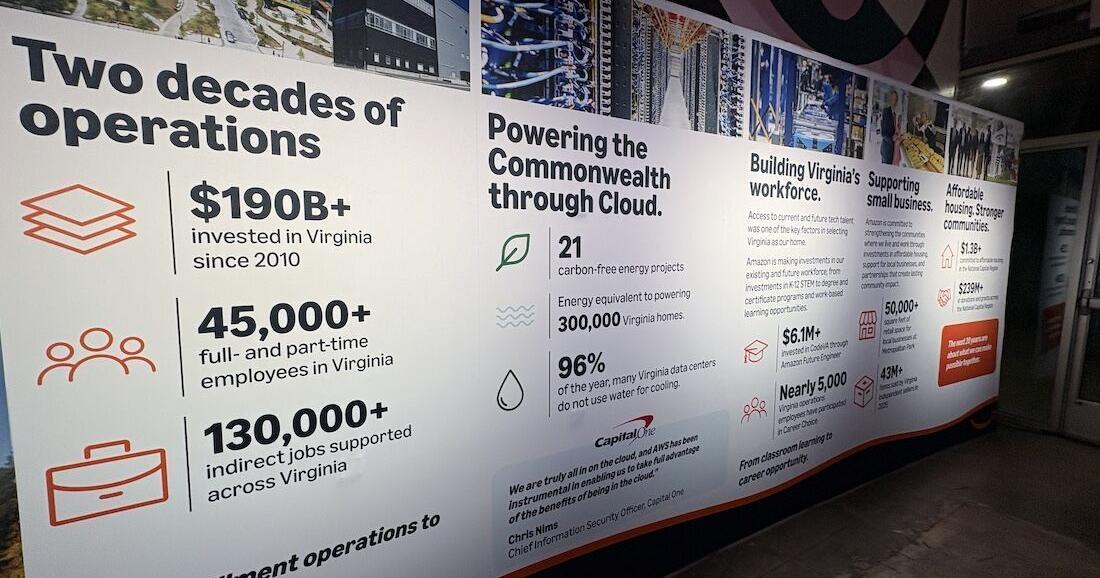
Amazon representatives said the company has put more than $190 billion into projects in Virginia since 2010. That figure includes HQ2, its East Coast headquarters in Arlington.
The company now counts more than 45,000 employees in the state. Schmidt credited the region's talent pool, describing local workers as mission-driven and inclined to stay with an employer for the long haul.
He pointed to his own hiring as evidence: he has brought on 135 former FBI employees, who have stayed with Amazon for an average of 18 years.
State Officials Highlight Workforce Ties
Stewart Ackerly, Virginia's deputy secretary for commerce and trade, praised the company's long-term commitment, noting that Amazon opened its first data centers in Northern Virginia two decades ago and launched a global technology business from there.
Ackerly also pointed to Amazon's workforce development efforts, including a recently announced plan to fund the state's community college system. The initiative is meant to help students prepare for careers in information technology, healthcare and the skilled trades.
He described Northern Virginia as one of the world's most significant technology corridors, with the cloud and AI infrastructure built there supporting the broader global economy, while stressing that the people behind it matter as much as the hardware.
What the Anniversary Signals for the Region
The celebration underscores how deeply cloud computing has become tied to Northern Virginia's economy, and how a decision to accommodate a small team's wish to stay home helped steer that outcome.
At the same time, Loudoun's move to pause new data center applications shows that local communities are pushing back on the physical footprint of that growth. For companies building cloud and AI infrastructure, the balance between economic investment, workforce programs and community acceptance is likely to remain a central issue in the years ahead.
Source: LoudounNow.com